Author: JA of Greater Washington
Financial Literacy
Published:
Thursday, 05 Mar 2026
Sharing
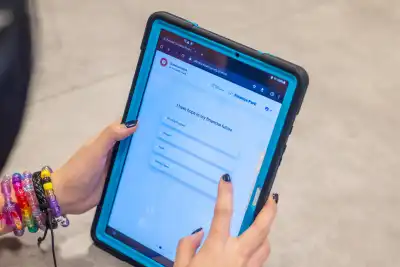
Image caption: A student reviews a question about how much hope she has for her financial future.
Click here to read the full article!
On a Friday in January, Glasgow Middle School eighth grader Zach has become an auto damage insurance investigator, making $90,000 a year, with a 640 credit score and no children.
His classmate Adoneyas, is similarly child-free, working as a traffic technician who earns $68,000 a year, with a 720 credit score. Meanwhile, their friend Alan is a single father with a more challenging financial outlook: he works in sales, earning $45,867 a year to support him and his child, with a 590 credit score.
Each eighth grader is participating in an annual rite of passage for Fairfax County Public School eighth grade students. They’re attending a day-long field trip to Junior Achievement’s Finance Park, which aims to give students a “crash course in financial reality.” The JA Finance Park experience provides students with the opportunity to explore financial planning and career pathways.
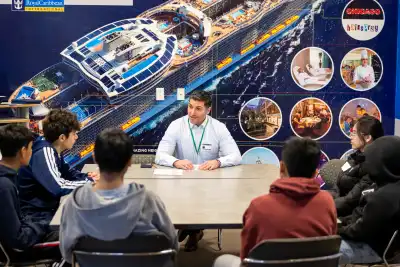
Image caption: A volunteer discusses different vacation options with Glasgow students learning to set personal budgets.
The effort aligns with FCPS Strategic Plan 2023-30 and Portrait of a Graduate goals of providing students with the foundations of financial literacy. Students are required to take one economics and personal finance course prior to high school graduation.
On the field trip, students are assigned life scenarios at random that include a career, income, credit score, educational background and family structure. They pay their taxes, calculate their net monthly income, and then visit more than a dozen storefronts where they learn about the financial realities of adulthood: shopping for insurance, home appliances, cars and a mortgage, while prioritizing saving for vacations, leisure activities like concerts or manicures or sporting events, and pet care.
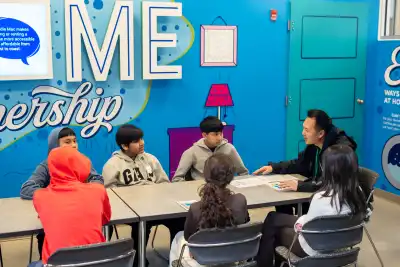
Image caption: Students discuss the costs associated with home-ownership versus renting with a Finance Park volunteer.
JA Finance operates using a “pay yourself first “philosophy and students are expected to prioritize savings and debt payments as a regular monthly expense.
"This annual trip to Finance Park is a vital experience for our eighth graders," Glasgow Principal Lisa Barrow said. "Through these hands-on, role-playing experiences, our students leave understanding the value of smart budgeting, the power of saving and investing, and the true cost of adult life."
Straight off the bat, most students are overjoyed at the prospect of spending their newfound income. They soon learn maturity comes with costs as volunteer after volunteer hits them with the typical expenditures that are part of most household budgets.

Image caption: Glasgow students learn they can save money by shopping at thrift stores.
“Water, sewer, and trash. Those are all utilities that you have to keep in mind when you're budgeting,” the students learn, while they swap tips for reducing energy costs like leaving items unplugged when not in use, taking shorter showers, or installing solar panels.
“Excited about your new car? How many of you guys know what insurance is?” another volunteer asks. Even the adult overseeing a session on pets had a reality check for students.
“Our cat, one day we woke up, and he couldn't poop,” the volunteer says. “We had to take it to the emergency vet to get X-rayed and treated. The total cost was $10,000, but my wife and I had pet insurance, so all we had to pay was $900.”

Image caption: Two students begin to develop their household budget using their randomly assigned life circumstances.
"It is time to pay taxes," another volunteer tells them. “Remember that income you have with your identity, well, gross monthly income is before taxes are taken out. Net monthly income is the amount you have to spend each month.”
Students also become acquainted with flexible spending accounts for medical expenses, and savings for retirement through 401ks or IRAs.
“The JA Finance Park experience prepares young people to be future-ready by exposing them to hands-on, practical experiences that develop critical skills such as problem-solving, decision-making and collaboration,” Junior Achievement Finance Park says of the program’s goals.
Some adult volunteers share tips, like Kaitlin who oversees the groceries room. She recommends going to warehouse clubs like Costco, buying generic or store brand items, using coupons or buying items on sale, to cut down on food costs.
Girish, an employee of one JA’s corporate partners volunteering at a storefront, doles out car advice.
“One student came in and said they wanted a yellow Lamborghini,” he said. “I’m not going to crush his dreams and say don’t buy that. But I did say wait until you're 25, get a good job, then buy used or lease — buy one with 10,000 miles on it.”
A third volunteer reminds students about investing, whether through home ownership, the stock market, or by creating their own company. “Let your money do some work for you. But do your research first.”
After visiting each storefront, students are ready to create their own household budget, sitting down to crunch spending and income numbers by building a budget that’s aligned with their net monthly income.
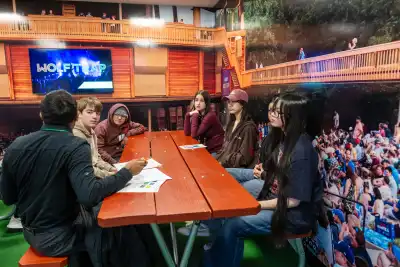
Image caption: Students consider how to spend money on leisure activities as part of their household budget.
They soon learn their dreams might not yet be reality, like “single dad” Alan, whose 590 credit score and comparatively low income impedes his ability to get a mortgage for the house of his dreams.
Adoneyas, the “traffic technician,” is meanwhile living a practical life. “You have to put some thought into this. If you’re single, who needs a big house or even a two bedroom apartment?”
His classmate Emma, a vegan who says she doesn’t mind the cold or candlelight, keeps costs low on her $60,000/year income as a metal fabricator by spending the bare minimum on groceries and utilities, saying not buying meat should help save money, as will using a fireplace, extra blankets and candlelight sometimes instead of electricity. She likes cheap hobbies, like hiking, reading, and playing soccer in a park, she says.
Things are going well for Emma, until she’s dealt a blow: her basement flooded. Savings are dwindling and she’s forced to re-evaluate her one area of luxury spending: vacations.
Zach, whose assumed identity came with the highest paying salary of the bunch, is meanwhile investing in a side business that brings in an extra $500 a month. While Alan looks for cheaper housing for himself and his hypothetical child, Zach is now weighing charitable donations as part of his budget.
“Today taught me you need to plan and to try to spend below your budget,” Zach says. “You also have to take chances, make investments. I have to admit, my character got lucky though — my investments paid off into a profitable second income, while other people did everything right and went broke after their basement flooded. That’s something to remember as well.”
Get Involved with Junior Achievement!
Select a button below to see how you or your organization can get involved with Junior Achievement of Greater Washington, Inc..